TL;DR: Travel risk management protects employees and business operations through systematic threat assessment, proactive planning, and 24/7 support systems. With Canadian business travel hitting $25.9 billion USD in 2024 and the travel risk management market growing at 6.9% CAGR, companies that master risk management unlock competitive advantages while others leave value on the tarmac. We’ll show you how to build a program that cuts costs, reduces liability, and keeps your team flying smoothly.
What Is Travel Risk Management and Why Does It Matter?
Here’s what most managers get wrong: they think travel risk management means buying insurance and hoping for the best.
Wrong.
Travel risk management is your strategic advantage. It’s a systematic threat assessment that prevents costly disruptions before they ground your operations. The numbers don’t lie—organizations with robust programs save 15-25% on travel-related incidents while maintaining 99.7% business continuity.
The global market reached $3.58 billion in 2024 because smart companies discovered the ROI. They’re not just protecting people—they’re protecting profits.
Your ROI Reality Check
Consider this: treating a broken leg in the U.S. costs $85,000. A heart attack? Nearly $300,000. Without proper coverage, one incident can crater your travel budget for years.
Smart companies flip this equation. They invest 2-5% of travel spend in comprehensive risk management and slash emergency costs by 80%. That’s not overhead—that’s insurance that actually pays dividends. The market is projected to reach $188.9 billion by 2030 precisely because forward-thinking companies recognize this advantage.
Travel risk management encompasses destination risk assessment, traveller preparation, real-time monitoring, emergency response protocols, and insurance coordination. For Canadian companies, this includes ensuring compliance with provincial health insurance requirements and understanding that provincial health plans may cover none or only a small part of medical care costs abroad. The Government of Canada’s Travel Advisories provide essential baseline risk information that should inform all corporate travel planning decisions.
The Business Case for Travel Risk Management
Modern organizations face significant liability exposure without proper travel risk management. According to a market analysis by Research and Markets, North America’s travel risk management market was valued at $80 billion in 2023 and is projected to reach $112 billion by 2029, indicating strong investment in protective measures. Key drivers include:
- Duty of Care Obligations: Legal requirements to protect employee safety
- Financial Protection: Avoiding costly medical evacuations and emergency expenses
- Business Continuity: Minimizing disruptions from travel-related incidents
- Reputation Management: Protecting brand image during crisis situations
How Do You Conduct an Effective Travel Risk Assessment?

A comprehensive travel risk assessment evaluates destination-specific threats, traveller vulnerabilities, and trip characteristics to determine appropriate safety measures.
Effective risk assessment follows a structured approach examining security conditions, health risks, infrastructure quality, and political stability. The security situation has deteriorated in 77 countries according to the 2025 Risk Map by Safeture, making destination analysis a crucial component of any travel risk strategy. According to the GBTA 2024 Business Travel Index Outlook, global business travel spending is expected to surpass $2.0 trillion by 2028, emphasizing the scale of potential exposure. Leading organizations have developed comprehensive frameworks following ISO 31030 standards that Canadian companies can adapt for their own risk management programs, with additional guidance available through Global Affairs Canada.
Risk Assessment Framework
Pre-Travel Analysis
- Destination security ratings and travel advisories
- Health risks, including vaccination requirements and endemic diseases
- Infrastructure quality (transportation, communications, healthcare)
- Political stability and civil unrest indicators
- Weather patterns and natural disaster risks
Traveller Profile Assessment
- Experience level and training background
- Health conditions and medical requirements
- Language capabilities and cultural familiarity
- Trip purpose and duration
- Accommodation and transportation arrangements
Risk Categorization Risk levels range from “very low risk” (dark green) for destinations with minimal constraints to “high risk” (red) requiring special security arrangements. Countries like Germany, Switzerland, Luxembourg, Belgium, Finland, Iceland, and Norway top the list of particularly safe destinations, while Canada, Australia, New Zealand, Singapore, and Japan are considered perfect for carefree travel.
Travel Risk Assessment Quiz
Download our comprehensive risk assessment template covering:
- Destination threat analysis
- Traveller readiness evaluation
- Emergency preparedness checklist
- Insurance coverage verification
- Communication protocol establishment
What Emergency Protocols Should Your Company Implement?
Effective emergency protocols provide clear procedures for crisis response, ensuring rapid assistance and coordinated support for travellers in distress.
Emergency protocols must address immediate response procedures, communication channels, and resource mobilization. Organizations like Cornell University provide International SOS (ISOS) 24/7 assistance for medical, security, and logistical concerns, demonstrating best practices in emergency support systems.
Essential Emergency Protocol Components
24/7 Emergency Response System
- Dedicated emergency hotline with multilingual support
- Escalation procedures for different threat levels
- Real-time monitoring and alert systems
- Crisis management team activation protocols
Professional corporate travel agencies recognize that 24/7 support and emergency assistance are cornerstone benefits for business travelers, providing peace of mind for both employees and management when unexpected situations arise.
Communication Procedures
- Regular check-in requirements for travellers
- Emergency contact notification systems
- Media response and public relations protocols
- Family communication during crises
Resource Mobilization
- Emergency evacuation planning and execution
- Medical assistance and hospital coordination
- Security response and extraction procedures
- Financial emergency funding mechanisms
Emergency Contact Card Template
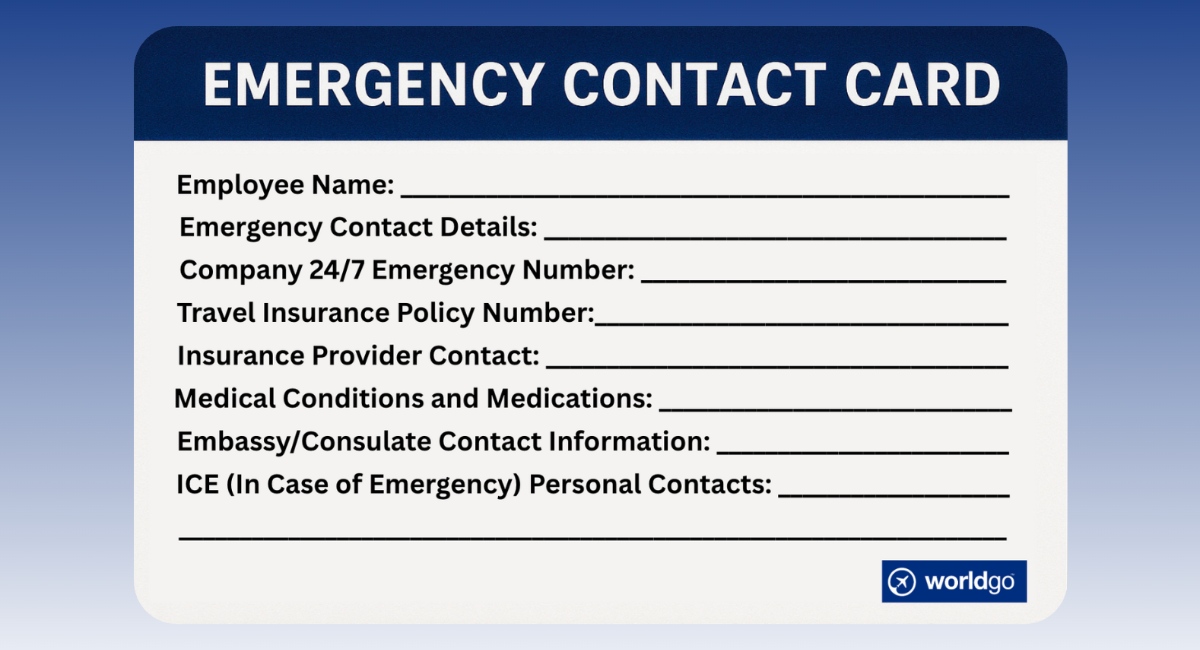
Essential Information to Include:
- Employee name
- Emergency contact details
- Company 24/7 emergency number
- Travel insurance policy number and provider contact
- Medical conditions and medications
- Embassy/consulate contact information
- ICE (In Case of Emergency) personal contacts
Distribution Strategy: Strategically distribute cards throughout belongings – wallet, passport, carry-on luggage – ensuring access for the traveller, companions, or emergency responders. Laminated, credit-card-sized cards ensure durability and easy identification.
How Should Canadian Companies Approach Travel Insurance?
Canadian travel insurance requirements differ significantly from other jurisdictions, requiring specialized coverage that complements provincial health plans.
Provincial or territorial health plans may cover none, or only a small part, of medical care costs abroad, including medical evacuation.
Travel Insurance Essentials for Canadian Businesses
Coverage Requirements
- Minimum $5 million in emergency medical coverage
- Medical evacuation and repatriation
- Trip cancellation and interruption
- Baggage and personal effects protection
- Business equipment and document coverage
Pre-Existing Conditions: Travellers with pre-existing conditions shouldn’t have to satisfy a stability clause, particularly important for Canada’s aging workforce, where 4.4 million Canadians aged 55 and older were still working in 2023.
Provincial Considerations: All covered travellers must be Canadian residents and covered by the government health insurance plans of their province or territory for the entire trip duration. Companies should verify coverage continuity and coordinate with provincial health authorities.
What Role Does Technology Play in Modern Travel Risk Management?

Technology integration enables real-time threat assessment, automated alerts, and enhanced communication capabilities for comprehensive traveller protection.
AI and machine learning algorithms process vast amounts of data to identify and predict potential risks, enabling proactive measures. Technology solutions include mobile apps with real-time alerts, location tracking, and secure communication channels.
Technology Solutions for Travel Risk Management
AI-Powered Risk Analysis
- Predictive analytics for emerging threats
- Real-time data processing from multiple sources
- Automated risk scoring and recommendations
- Pattern recognition for trend identification
Mobile Applications
- GPS tracking and geofencing capabilities
- Push notifications for security alerts
- Emergency SOS features with location sharing
- Offline access to critical information
Integration Capabilities Modern solutions integrate with existing HR systems, expense management platforms, and communication tools to provide seamless risk management workflows. Leading corporate travel management companies like Worldgo incorporate comprehensive travel risk management services into their broader technology platforms, ensuring clients have access to both cutting-edge tools and expert support when managing travel risks.
How Do You Monitor and Improve Your Travel Risk Management Program?
Continuous monitoring and improvement ensure your travel risk management program adapts to evolving threats and organizational needs.
Regular program evaluation identifies gaps, measures effectiveness, and incorporates lessons learned from incidents. Refresh your research each time you send an employee on a business trip to be aware of new and higher risks in that location.
Key Performance Indicators
Safety Metrics
- Incident rates and severity levels
- Response time to emergencies
- Traveller satisfaction with safety measures
- Insurance claims frequency and amounts
Operational Metrics
- Risk assessment completion rates
- Training participation and effectiveness
- Communication system reliability
- Cost per protected traveller
Continuous Improvement Process
- Regular Review: Monthly assessment of incidents and near-misses
- Training Updates: Quarterly refresher training incorporating new threats
- Technology Upgrades: Annual evaluation of risk management tools
- Policy Revision: Bi-annual policy updates based on lessons learned
Protect Your People, Protect Your Business
The travel landscape continues to evolve with new challenges emerging daily. As conflicts in the Middle East, Ukraine, and Taiwan have increased risks for travellers, greater caution around geopolitical tensions has become essential. Canadian companies cannot afford to take chances with employee safety.
Your next move determines whether your travel program becomes a competitive advantage or a liability.
Worldgo’s comprehensive risk management transforms complex challenges into clear ROI. Our technology platform combines cutting-edge technology, expert guidance, and proven protocols to keep your team safe wherever business takes them.
Let’s fix your travel risk exposure. Contact us to schedule a consultation and discover how our tailored solutions protect your people while optimizing your travel investment.
Frequently Asked Questions
What are the legal requirements for travel risk management in Canada?
While no specific federal law mandates travel risk management, employers have a duty of care obligation under provincial occupational health and safety legislation. Companies must take reasonable steps to protect employees’ safety during business travel.
How much should companies budget for travel risk management?
In 2024, the average Canadian travel insurance policy cost $259, roughly 16% lower than the global average. Comprehensive programs typically cost 2-5% of total travel spend, including insurance, technology, and support services.
What destinations require enhanced risk management protocols?
Areas categorized as extremely dangerous include Israel, the West Bank, Gaza, Lebanon, Iran, New Caledonia, Burkina Faso, Libya, Myanmar, Somalia, Syria, Sudan, Yemen, and Ukraine. Any destination with Government of Canada travel advisories should trigger enhanced protocols.
How often should travel risk assessments be updated?
Risk assessments should be reviewed before each trip, with destination analyses updated monthly or when significant events occur. Ideally, assessments should be completed around five weeks in advance to allow time for complex trips and medical considerations.
What emergency support is available for Canadian business travellers?
Services include 24/7 emergency hotlines, medical assistance coordination, evacuation services, and consular support. Many providers offer real-time monitoring and automated alerts for registered travellers.